The Circular Economy is a concept that rethinks long-term economic practices, transforming waste into new raw materials. Instead of disposing of waste in common trash causing damage to nature, the circular economy proposes a correct disposal of certain materials so that they return to the production cycle, being a solution to minimize the human impact on the environment.
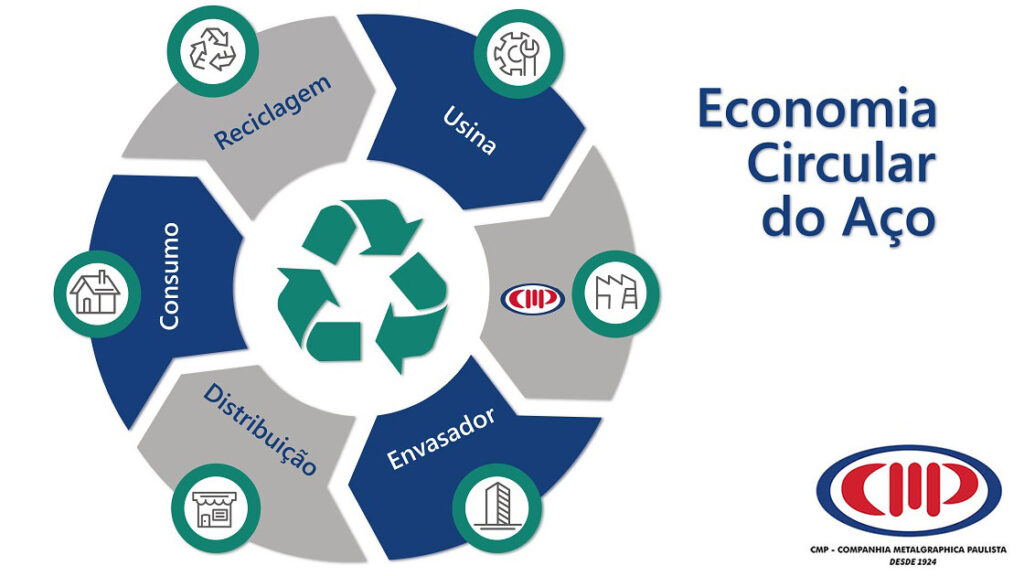
In the case of steel packaging, the Circular Economy concept in Brazil already has a structure in place thanks to the union of several companies, such as CMP – Companhia Metalgraphica Paulista and entities such as Prolata. The circularity of steel packaging begins with its production in mining plants, where the extracted iron ore is transformed into steel and sent to manufacturers who will transform it into packaging. These will be bottled with the final product and sent to points of sale, where they will be consumed and sent for recycling. The cooperatives handle this material and send it back to the mills, which will transform the scrap into its initial state.
When we talk about recycling steel packaging, its great differential is that it is 100% recyclable, which fits very well with the concept of circular economy. Steel does not lose its physical properties and can be recycled countless times without losing its characteristics. A recycled steel can will turn into a new steel product such as scissors, nail, refrigerator, auto part, or even a new can.
The Circular Economy concept is very important to reduce environmental impacts, but for this it is necessary that all parts of the chain contribute. The consumer is a fundamental part of a functional Circular Economy, as from the correct disposal of steel packaging, cans can return to the production cycle, contributing to the environment and the economy.
Written by CMP – Companhia Metalgraphica Paulista